How to Read a Cash Flow Statement (Cash vs Profit)
Here is a fact that surprises most new investors: a company can report rising profits for years and still collapse. It happens more often than you would think, and when it does, the warning was almost always sitting in plain sight in one financial statement that beginners tend to skip.
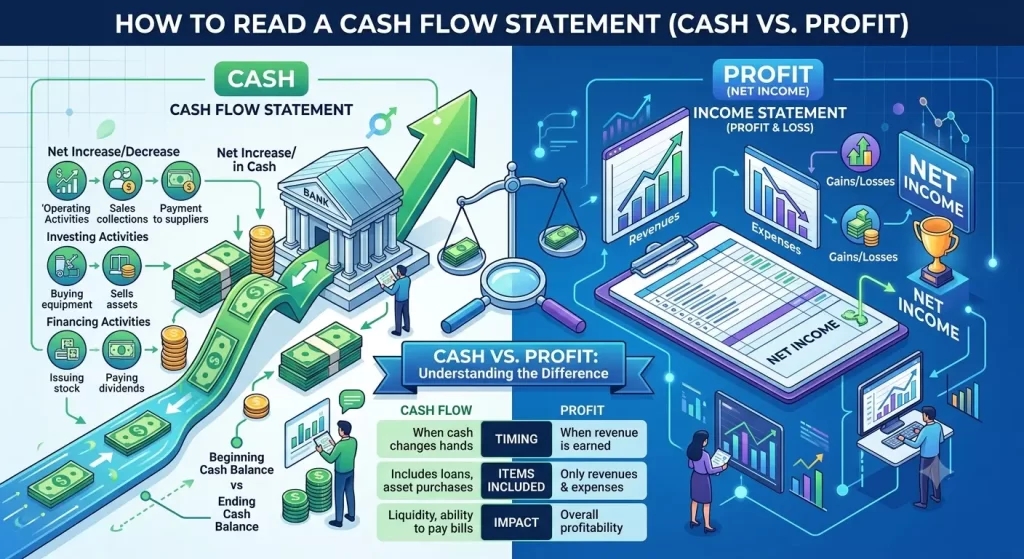
That statement is the cash flow statement. The profit and loss account can be flattering, because profit is partly a matter of accounting judgment, sales booked on credit, and non-cash entries. Cash is different. Cash is the money that actually moved in and out of the bank, and it is much harder to dress up. As the old investing line goes, profit is an opinion, cash is a fact.
This is a plain-English guide to reading a cash flow statement: what it is, why cash tells you more than profit, the three sections it splits into, the single number that matters most (free cash flow), and the red flags that reveal a company in trouble long before the profit line does.
The short version
- The cash flow statement tracks the actual cash that moved in and out of a company over a period, unlike the profit and loss account, which can include money not yet received.
- It has three sections: operating (cash from the core business), investing (cash spent on or earned from assets), and financing (cash from loans, share sales, and dividends).
- Operating cash flow is the most important line. A healthy company generates strong cash from its actual business, not just from borrowing.
- Free cash flow (operating cash flow minus capital spending) is the number professional investors watch most closely.
- The classic warning sign is profit rising while operating cash flow falls or turns negative. It means the reported profit is not turning into real money.
What a cash flow statement actually is
The cash flow statement answers one blunt question: where did the money come from, and where did it go, over this period? It covers a stretch of time, a quarter or a year, and it deals only in real cash movements.
That makes it the perfect companion to the other two statements. The profit and loss account tells you whether the company earned a profit. The balance sheet tells you its financial position on one date. The cash flow statement tells you whether the profit turned into actual cash and how the company funded itself. You need all three, because each can hide what the others reveal.
The reason profit and cash differ comes down to how accounting works. Under accrual accounting, a company records a sale when it makes it, not when it gets paid. So a firm can book a big profitable order in March, report it as profit, and still be waiting for the customer’s cheque in September. On paper, profitable. In the bank, empty. The cash flow statement strips that illusion away.
Why cash beats profit
Profit is a calculated figure, and calculations involve choices. How fast to depreciate an asset, when to recognise revenue, how to value inventory, these are judgment calls that shift the profit number without a single rupee changing hands. None of that is necessarily dishonest, it is just how accrual accounting works. But it means profit can be managed.
Cash is far more stubborn. Either the money arrived or it did not. That is why seasoned investors trust cash flow more than the profit line, and why a company that consistently converts its profit into cash is worth more than one that reports fat profits it never seems to collect. When profit and cash flow tell different stories over several years, believe the cash.
This is not to say profit does not matter. It does. The point is that profit without cash to back it up is a promise, not a result, and the cash flow statement is where you check whether the promise is being kept.
The three sections, in plain English
Every cash flow statement splits into three parts. Reading them in order tells you a story about how the business actually runs.
Cash from operating activities
This is the cash the company generates from its core business, selling its products or services, after paying for the day-to-day costs of running it. It starts from net profit and adjusts for non-cash items and changes in working capital (money tied up in inventory and unpaid customer bills).
Operating cash flow, often shortened to CFO, is the single most important line in the statement. A strong, growing CFO means the business itself throws off real cash, which is the whole point of a business. If a company cannot generate cash from operations, nothing else on the statement can save it for long.
Cash from investing activities
This section covers cash spent on or received from long-term assets: buying machinery and property, building capacity, acquiring other companies, or selling off assets. The big item here is capital expenditure (capex), the money a company spends to grow or maintain its operations.
For a healthy, growing company, this section is usually negative, and that is a good thing. Negative investing cash flow means the company is reinvesting in itself. You only worry when a company is selling off its core assets to raise cash, which can be a sign of distress.
Cash from financing activities
This section shows how the company raises and returns money to its funders. Cash comes in from taking loans or issuing new shares, and goes out through repaying debt, buying back shares, and paying dividends.
The story here is about dependence. A young company might rely on financing inflows to fund its growth, which is normal. But a mature company that keeps borrowing or issuing shares just to keep the lights on, year after year, is waving a red flag. Ideally, a healthy business funds itself from operations and uses financing by choice, not necessity.
Free cash flow: the number that really matters
If you learn to read only one derived number from this statement, make it free cash flow.
Free cash flow (FCF) is operating cash flow minus capital expenditure. In plain terms, it is the cash left over after the company has paid to run and maintain its business, the money genuinely free to repay debt, pay dividends, buy back shares, or build a war chest.
Investors love it because it is hard to fake and it captures real financial strength. A company with consistently positive and growing free cash flow has options and resilience. A company that never produces free cash flow, however impressive its profit looks, is running to stand still.
What healthy cash flow looks like
Put the pieces together and a few signs mark out a financially sound company.
- Positive and growing operating cash flow. The core business reliably produces cash, and produces more of it over time.
- Operating cash flow that keeps pace with profit. Over several years, CFO should be broadly in line with, or better than, net profit. A big persistent gap where profit far exceeds cash is a warning.
- Positive free cash flow. The company funds its own investment and still has cash to spare.
- Financing that is a choice, not a lifeline. The company is not surviving on a constant drip of new loans and share sales.
A simple worked example
Numbers make it concrete. Here is a simplified annual cash flow statement for an imaginary company, Brightwear Ltd (in ₹ crore).
| Item | ₹ crore |
|---|---|
| Net profit | 100 |
| Add: depreciation (non-cash) | 30 |
| Less: increase in working capital | (40) |
| Cash from operating activities (CFO) | 90 |
| Capital expenditure | (50) |
| Cash from investing activities | (50) |
| New loan raised | 20 |
| Dividend paid | (15) |
| Cash from financing activities | 5 |
| Net increase in cash | 45 |
Read it in a minute. The company earned ₹100 crore of profit and converted ₹90 crore of it into operating cash, a healthy conversion that tells you the profit is largely real. It spent ₹50 crore on capex to grow, and even after that it produced free cash flow of ₹40 crore (CFO of 90 minus capex of 50). It topped up with a modest loan and paid a dividend, ending the year with ₹45 crore more cash than it started. This is a business standing on its own feet.
Now picture the same profit of ₹100 crore, but with operating cash flow of only ₹20 crore because unpaid customer bills ballooned, and financing showing a ₹60 crore loan taken just to stay liquid. Identical profit, completely different health. The reported profit is not becoming cash, and the company is leaning on debt to survive. That contrast is the entire reason this statement exists.
Red flags in the cash flow statement
A handful of patterns should stop you cold.
- Profit rising while operating cash flow falls or turns negative, the classic sign that reported profits are not translating into money.
- Operating cash flow consistently below net profit, year after year, which suggests profits are stuck in receivables or inventory.
- A company funding itself mainly through financing, repeatedly borrowing or issuing shares to cover a shortfall from operations.
- Free cash flow that is persistently negative for a company that is supposed to be mature and profitable.
As always, one odd year is a question, not a conviction. It is the multi-year pattern that tells the truth.
How the three statements fit together
No financial statement stands alone, and the cash flow statement is the one that keeps the other two honest. The profit and loss account shows whether the company earned a profit. The balance sheet shows its financial position and how much it owns and owes. The cash flow statement shows whether that profit became real money and how the company stayed funded. Read them as a set, alongside the key ratios you can pull from them, and you get a picture no single document can give you. A company that looks great on profit but weak on cash, or strong on the balance sheet but bleeding operating cash, is telling you something important in the gaps between the three.
How beginners should actually use it
Start simple. Each time you look at a company, compare its operating cash flow with its net profit. If cash flow keeps up, the profit is probably real. Then check free cash flow to see whether the company genuinely generates spare cash. Finally, look at the trend over three to five years rather than fixating on a single quarter, which can swing for ordinary timing reasons.
Do that much and you will already spot problems that people who only read the profit line will miss entirely, which is exactly how a “profitable” company ends up surprising everyone but the few who read its cash flows.
A quick note
This article is general education, not investment advice, and it is not a recommendation to buy or sell any security. Reading a cash flow statement is one part of analysing a company, not a complete method, and the figures in the example are illustrative. Consider your own goals and, for guidance tailored to your situation, consult a SEBI-registered investment adviser.
FAQs
What is a cash flow statement in simple terms?
It is a financial statement that tracks the actual cash moving in and out of a company over a period. Unlike the profit and loss account, which can record sales before payment arrives, the cash flow statement deals only in real money received and spent, which makes it a reliable check on a company’s financial health.
Why is cash flow more important than profit?
Because profit involves accounting judgments and can include money not yet collected, while cash is money that genuinely changed hands and is far harder to manipulate. A company can report profits and still run out of cash, so cash flow often reveals trouble that the profit figure hides.
What are the three sections of a cash flow statement?
Operating activities (cash generated by the core business), investing activities (cash spent on or received from long-term assets like machinery), and financing activities (cash from loans and share issues, minus repayments and dividends). Operating cash flow is generally the most important of the three.
What is free cash flow?
Free cash flow is operating cash flow minus capital expenditure. It represents the cash a company has left after paying to run and maintain its business, money that is free to repay debt, pay dividends, or reinvest. Consistently positive free cash flow is a strong sign of financial health.
What is a cash flow red flag?
The most common one is profit rising while operating cash flow falls or turns negative, which suggests reported profits are not becoming real cash. Relying on constant borrowing or share issues to stay afloat, and free cash flow that stays negative for a mature company, are also warning signs.