Sector rotation strategy in India: how to ride market cycles
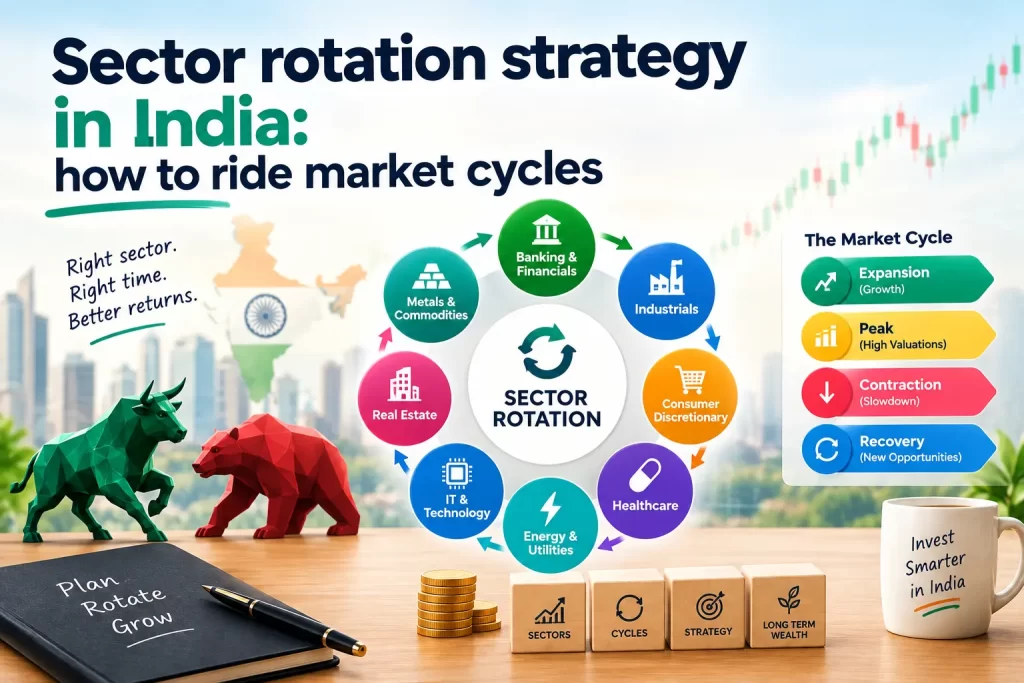
Most beginners think of “the stock market” as one thing that goes up or down together. It does not work that way. In any given year, some sectors quietly power ahead while others go nowhere, and the leaders keep changing. IT leads for a stretch, then banks take over, then autos have their run, then everyone piles into FMCG when things get shaky.
Sector rotation is the strategy of noticing that pattern and moving with it, shifting money toward the sectors that tend to do well in the current phase of the economy and away from the ones that are about to struggle. Done well, it can improve your returns and cushion your downside. Done badly, it turns into expensive guesswork.
This is a framework, not a hot-stock list. By the end you will understand how the Indian economic cycle drives sector performance, the difference between cyclical and defensive stocks, what moves the big five sectors (IT, banking, auto, pharma, FMCG), and a step-by-step way to actually put it into practice without over-trading yourself into losses.
The short version
- Sector rotation means adjusting your holdings toward the sectors favoured by the current economic phase, rather than buying one basket and ignoring the cycle.
- The economy moves through phases (recovery, expansion, peak, slowdown), and different sectors lead in each one.
- Cyclical sectors (auto, banking, metals, real estate) swing hard with the economy. Defensive sectors (FMCG, pharma, utilities) hold up better when it weakens.
- You do not need to trade constantly. A practical version is a stable core plus a small tactical tilt toward one or two sectors that fit the phase.
- Rotation costs money in brokerage and taxes, and getting the timing wrong is common, so for many beginners a diversified fund with a light sector tilt beats aggressive rotation.
What is sector rotation, really?
Sector rotation is the movement of investment money from one industry group to another as the economy changes. Large institutional investors do this constantly, and it is a big reason why sector leadership keeps shifting.
The logic is simple. Companies in the same sector tend to share the same tailwinds and headwinds. When interest rates fall, banks and carmakers and homebuilders all tend to benefit together. When the economy slows and people get cautious, they cut back on a new car or phone long before they cut back on soap, biscuits, and medicine, so consumer staples and pharma hold up while cyclical sectors sag. Rotation is just the practice of leaning into whichever group the current conditions favour.
You do not need to predict the future to use it. You need to read where the economy is now and position sensibly for it.
The economic cycle and how sectors respond
The economy moves in cycles, and while no two are identical, the broad phases repeat. Here is how sector leadership typically shifts through them. Treat this as a tendency, not a timetable.
- Early recovery (rates low or falling, growth picking up after a slump). Rate-sensitive and cyclical sectors usually lead first. Banks and financials benefit as credit demand revives, and interest-rate-sensitive sectors like autos and real estate get a lift from cheaper loans.
- Expansion (growth broad and confident, corporate profits rising). Cyclicals keep running, and capital-heavy sectors join in. Capital goods, industrials, and metals tend to do well as companies invest and build, and consumer discretionary spending rises.
- Peak / late cycle (growth strong but rates rising to cool inflation). Leadership narrows. Commodities and energy can do well late in the cycle, while rate-sensitive sectors start to feel the squeeze of higher borrowing costs.
- Slowdown / contraction (growth weakening, sentiment cautious). Money rotates into defensives. FMCG, pharma, and utilities tend to outperform because demand for their products barely changes even in a downturn.
The takeaway is that there is rarely a “bad time to invest” across the board. There is usually a sector that suits the moment. The skill is identifying the moment.
Cyclical vs defensive: the two teams
If you remember only one distinction from this article, make it this one. Almost every sector falls into one of two camps.
Cyclical sectors rise and fall with the health of the economy. When growth is strong and people feel confident, these boom. When the economy slows, they get hit hardest. In the Indian market, the main cyclicals are:
- Automobiles, because a car or bike is a big, postponable purchase people delay when money is tight.
- Banking and financials, whose fortunes track credit growth, interest rates, and loan defaults.
- Metals and mining, tied to industrial demand and global commodity prices.
- Real estate and construction, highly sensitive to interest rates and income confidence.
- Capital goods and industrials, which depend on companies and governments spending on new capacity.
Defensive sectors provide products people buy in good times and bad, so their earnings stay steadier through a downturn. The main defensives are:
- FMCG (fast-moving consumer goods), the soaps, biscuits, and toothpaste people never stop buying.
- Pharma and healthcare, because illness does not wait for the economy to recover.
- Utilities, since power and water demand stays fairly constant.
IT sits a little apart. It is not a classic defensive, but because Indian IT earns heavily in dollars by serving global clients, its fortunes depend more on the US economy and the rupee-dollar rate than on the Indian cycle, which makes it behave differently from domestic sectors.
The practical use of this split: when you expect the economy to strengthen, tilt toward cyclicals for the bigger upside. When you expect it to weaken, tilt toward defensives to protect your capital.
The big five sectors, and what actually moves them
The brief here covers the five sectors most retail investors watch. Here is what drives each, and where it tends to fit in the cycle.
- Information technology (IT). Driven by global tech spending, US and European client budgets, and the rupee-dollar exchange rate. A weaker rupee helps, since revenue is in dollars and costs are largely in rupees. It is less tied to India’s domestic cycle and more to the health of Western economies, so it can act as a partial hedge when domestic growth wobbles.
- Banking and financials. The purest play on the domestic cycle. It benefits from credit growth, a healthy economy, and controlled bad loans, and it is sensitive to interest rates. Falling or low, stable rates and rising loan demand are good for the sector. This is a core cyclical and often the first to move in a recovery.
- Automobiles. A classic cyclical and rate-sensitive sector. Lower interest rates make vehicle loans cheaper, and rising incomes and confidence drive demand. Watch fuel prices, financing costs, and rural versus urban demand, since two-wheelers and tractors track rural income while cars track urban.
- Pharma and healthcare. A defensive with steady domestic demand, plus an export angle for companies selling generics abroad, which adds a currency and global-regulation dimension. It tends to hold up when the broader market is nervous, and can lag during a strong risk-on rally in cyclicals.
- FMCG. The textbook defensive. Demand is stable because these are everyday essentials, so earnings are predictable and the sector is prized for safety in downturns. The trade-off is that it rarely delivers explosive growth, and it can underperform badly when investors are chasing cyclical upside.
How to actually do sector rotation, step by step
Knowing the theory is easy. Applying it without hurting yourself is the hard part. Here is a practical, low-drama process.
- Read the current phase. Look at a few reliable signals rather than headlines: the RBI’s interest rate direction and stance, inflation trend, GDP growth, and corporate earnings momentum. Falling rates and reviving growth point toward early cycle. Rising rates to fight inflation point toward late cycle. You are trying to locate the economy on the map, not predict the exact turn.
- Match sectors to the phase. Use the cyclical-versus-defensive split and the phase guide above. Strengthening economy, lean cyclical. Weakening economy, lean defensive. You are tilting, not betting the whole portfolio.
- Rotate gradually, not all at once. Shift a portion of your money, and do it in steps. Nobody calls the turn perfectly, and moving in stages protects you from being completely wrong on timing.
- Use the simplest instrument that fits. You do not have to pick individual stocks. Sector and thematic mutual funds or sector ETFs (banking, pharma, IT, and so on) let you take a sector view in one purchase, with built-in diversification within that sector.
- Rebalance on a schedule, not on emotion. Review your tilts every quarter or half-year against how the cycle has moved. A calendar rebalance stops you from reacting to every scary day of news.
- Keep a diversified core. Rotation should be the tactical layer on top of a diversified base, not your entire portfolio. If your whole net worth is riding on one sector call, that is not rotation, it is gambling.
Actionable takeaway: decide in advance what share of your portfolio is the stable core (say 70 to 80%) and what share is the tactical sleeve you rotate (the rest). That single rule prevents most of the damage beginners do to themselves.
Which sectors for 2026?
This is the question everyone actually wants answered, so let me handle it honestly: the right answer is to read the current phase and apply the framework, because a “buy these sectors” list goes stale the moment the cycle turns.
Here is where India sits as of late 2026, based on the RBI’s August 2026 policy. The central bank cut rates through early 2026 and has since held the repo rate at 5.25% for four consecutive reviews, keeping a neutral stance. Growth is solid, with the RBI raising its FY27 GDP forecast to around 6.7%, and inflation is running near 5%, above the 4% target but driven mainly by food and fuel rather than broad price pressure. In plain terms, this is a steady-growth, post-easing environment: rates are low and stable, and the economy is expanding at a healthy clip.
What does the framework suggest in that setting? Low, stable interest rates and reviving credit demand are historically supportive for rate-sensitive and domestic-cyclical sectors, banking and financials, autos, and real-estate-linked names among them, because cheaper borrowing feeds both consumption and investment. Defensives like FMCG and pharma remain useful ballast rather than the likely leaders during a risk-on, growth-led phase, and IT continues to march to the tune of the US economy and the rupee more than the Indian cycle.
Read that as reasoning, not a recommendation. The environment can shift quickly if inflation flares, oil spikes, or growth stumbles, and the RBI’s next moves depend entirely on incoming data. Before you act on any “2026 sectors” view, confirm where the cycle actually is at the time you are reading this, because that is the whole point of the strategy.
The risks and the mistakes to avoid
Sector rotation sounds clever, and that is exactly why it trips people up. The common failures:
- Over-trading. Every rotation costs brokerage, STT, and capital gains tax, and equity gains sold within a year are taxed at 20%. Trade too often and the friction quietly eats the edge you were chasing.
- Bad timing. Sectors often start moving before the economic data confirms the phase, so by the time a trend is obvious in the news, a chunk of the move is done. Chasing yesterday’s winner is a classic way to buy the top.
- Abandoning diversification. Concentrating everything in the “right” sector removes your safety net if you are wrong, and everyone is wrong sometimes.
- Confusing a story for a signal. A hot narrative on business TV is not the same as a genuine shift in the cycle. Stick to your handful of signals.
A simpler version for most beginners
If all of this feels like a lot, that instinct is healthy, and there is a lighter way to use these ideas.
Keep the bulk of your money in a diversified equity fund or index fund that already spreads you across sectors, so you never miss the leaders entirely. Then, if you want, add a small tactical tilt, a modest position in one sector that fits the current phase, as your way of expressing a view without risking the whole plan. You get most of the benefit of thinking in cycles with a fraction of the effort and risk. And if even that feels like too much, staying broadly diversified and simply holding through the cycle remains a perfectly respectable strategy that beats most people’s attempts at rotation.
A quick note
This article is general education, not personalised investment advice, and nothing here is a recommendation to buy or sell any specific sector, stock, or fund. Sector performance and economic conditions change, all equity investing carries the risk of loss, and the macro figures cited reflect reporting current as of late 2026. Consider your own goals and risk tolerance, and ideally consult a SEBI-registered investment adviser before acting.
FAQs
What is sector rotation in the stock market?
Sector rotation is the strategy of shifting investment money between industry groups as the economy moves through its cycle, favouring the sectors likely to do well in the current phase and reducing exposure to those likely to struggle. The goal is to improve returns and manage risk by aligning your holdings with economic conditions.
Which sectors are cyclical and which are defensive in India?
Cyclical sectors, which rise and fall with the economy, include automobiles, banking and financials, metals, real estate, and capital goods. Defensive sectors, which stay steadier through downturns, include FMCG, pharma and healthcare, and utilities. IT is a special case, driven more by the US economy and the rupee than by India’s domestic cycle.
How do I know which phase of the economic cycle we are in?
Watch a few key signals: the RBI’s interest rate direction and policy stance, the inflation trend, GDP growth, and corporate earnings momentum. Falling rates with reviving growth suggest early cycle, while rising rates to control inflation suggest late cycle. No single indicator is definitive, so read them together.
Is sector rotation good for beginners?
It can be, but full active rotation involves timing risk and trading costs that often erode the benefit. A simpler and usually safer approach for beginners is a diversified core holding plus a small tactical tilt toward one sector that fits the current phase, rather than moving large sums frequently.
Does sector rotation increase my tax and costs?
Yes. Each time you sell to rotate, you may pay brokerage, STT, and capital gains tax. Equity gains on holdings sold within 12 months are taxed at 20% in India, so frequent rotation can significantly reduce net returns. This is a major reason to rotate gradually and infrequently.